



Categories: Talent Management
Build a process you and your managers can leverage to make your B2B sales talent a competitive advantage. The remote and hybrid work environment provides companies the opportunity to hire talent with fewer geographical restraints creating the ability for leaders to expand their talent pool. Your competition may be leveraging that talent pool to build its sales team, and may be swiping your top performers. If you're considering a renewed focus on your sales talent approach, ensure you have the right foundations to make people successful in your organization and avoid your top talent jumping ship.
Your most important asset is your people, and owning the talent management process is key to turning them into your sales organization’s biggest competitive advantage. With more options and more competition, you must ensure you’re maximizing your talent approach, starting by defining clear Success Profiles, recruiting proactively, and coaching consistently.
5 Proven Tips to Hire and Retain Top Sales Talent
1. Define Success Profiles to Hire and Coach Top Sales Talent
Revenue-driving sales teams often have a clear definition of the traits of top-performing sales talent within their specific organization. The leaders and managers in those organizations use those traits to create Success Profiles that they can use to hire, promote and coach against. A great Success Profile defines the fundamental attributes of someone successful in a specific position. This profile is not a job description. It’s a combination of:
- The success competencies for the position: the knowledge required to effectively perform the job.
- The success behaviors: what those competencies look like when the job is being performed effectively.
Get specific with your success profiles. Clearly define the knowledge, skills and behaviors people need to succeed in your sales organization. Build a success profile for each critical role in your go-to-market organization, from Chief Revenue Officer to BDR. Having defined profiles for each role can help you point reps and managers to what good looks like in their positions, giving you and your leaders something to coach against and drive accountability around.
2. Always be recruiting
Once you have a clear success profile, it becomes the gift that keeps on giving. Constantly leverage it to recruit and hire talent that will help you scale business growth. Recruiting top sales talent can be an ongoing, burdensome process for sales leaders. Focus on staying prepared for this rule of three:
- Someone will be promoted.
- Someone will resign or be fired.
- Someone will surprise you.
Sales talent management needs to be a consistent priority for you and your sales managers, if you want to attract, hire and retain top sales talent. Human resources can help, but they shouldn’t be the lead owner of your recruiting efforts. While staying consistent with your recruiting efforts can be overwhelming, there are simple tactics, tools and processes you can implement to support your managers and HR teams in improving your talent bench.
3. Meet your people where they are so you can build a team of top performers
Losing customers to the competition is bad enough — if your sales reps are running to the competition too, you have a talent process that you need to improve. Successful leaders take into account their people’s skill level and motivation to coach them to success. A simple matrix called the Skill/Will model provides an easy way for you to achieve the same outcomes. Use this framework as a way to improve your sales talent processes.
The Y-axis represents “Skill,” or a person's ability to do a given job. The X-axis represents “Will”, or his/her motivation. These four buckets give you the information you need to assess your people and adapt you and your manager’s leadership approaches accordingly.
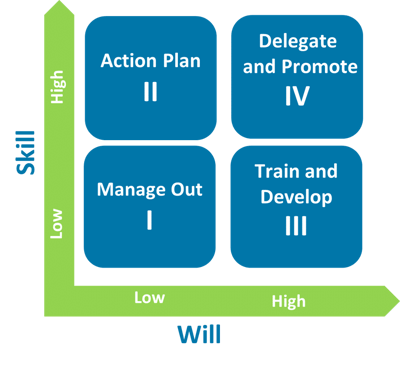
Understand what each box represents and how to coach your people accordingly. We just launched an entire podcast series on the Skill/Will coaching approach. Listen and share with other leaders in your organization, particularly front-line managers.
- Own Your Coaching Process
- Coaching Your 3s and 4s (high-will people)
- Coaching Your 1s and 2s (low-will people)
4. Coach your coaches to impact front-line results
Effective manager coaching can be the key component to getting a new hire up-to-speed quickly and driving repeatable performance from the best-of-the-best on the team. Can your managers provide effective feedback? Are they making an impact in opportunity coaching sessions, teaching repeatable sales skills and improving front-line execution? Do your managers stay in sync with new and seasoned reps on their team or is there evidence of a disconnect?
While there are endless difficult jobs in any business, the role of the front-line manager is one of the most difficult in the entire organization. Often sales managers aren’t trained for their critical roles. While they were promoted because they were excellent at sales, they are often underdeveloped at teaching the skills that came naturally to them as sellers. As a sales leader, you have the opportunity to build your managers into great sales coaches. Take a look at our comprehensive guide with the best resources for building strong sales coaches. In it, you'll find actionable tools and processes you can use to develop your sales managers into coaches that drive repeatable front-line impacts.
5. Implement a Management Operating Rhythm® to help your coaches make an impact
When it comes to building and retaining sales talent, participate in your own rescue by implementing a Management Operating Rhythm®, or MOR. When implemented effectively, a successful MOR provides you with an unrestricted line of sight into the performance of your sales teams. It equips you with the processes and tools leaders need to provide structured coaching to your entire team around current opportunities and other key sales activities.
Implement a MOR into your organization to ensure you and your managers execute the tactics necessary to retain talent and improve front-line execution.
Sales Talent Management Strategies: Tools & Action Steps
Frontline managers need both the right tools and clear steps to lower turnover and build bench strength. CSO Insights research shows many organizations struggle not just to recruit and onboard top sales talent but also to retain their best hires. Use the following tools and actions in tandem to create a unified talent management approach:
Key Tools
- Quarterly Assessments
“Assess individuals’ current level of skills and knowledge based on their competencies and behaviors. Review their successes as well as the areas where additional goals can be set.” Quarterly checkpoints keep performance visible and drive targeted development. - Developmental Action Plans
“Outline a plan to address and close the gaps identified in the Quarterly Assessment. This should help you create specific and timely development plans.” By converting assessment insights into concrete steps, you accelerate rep growth and increase engagement. - Team Capability and Succession Reviews
“Consider a comprehensive report that assesses the entire team on its current level of performance and potential.” Regular team-level reviews ensure you identify future leaders and avoid critical vacancies before they arise.
Action Steps to Improve Your Talent Management Approach
- Assess your current process
Dig into your sales organization’s state. What processes turn “B” sellers into “A”s? Are you over-investing in underperformers or overlooking coachable potential? - Meet reps where they are
Equip your sales managers to diagnose each rep’s skill and motivation, then tailor development to those individual needs. - Empower your managers
Provide mid-level and front-line managers with the coaching frameworks and tools they need to drive rep success. - Identify and address struggles early
Monitor pipeline health and rep performance to spot friction points—then deploy targeted support or training. - Lead from the front
Maintain visibility through regular check-ins, newsletters, and video meetings. Keep your team informed on initiatives, celebrate wins, and model the behaviors you expect.
Building a Feedback-Driven Culture
Think about your own feedback strategy with your sales team. Where have you struggled in the past? What techniques have been the most successful? Assess your past behaviors to help you build a pattern for future success. Keep in mind that how you deliver feedback can make the difference between a high-performing sales team and one that is disengaged and unmotivated.
For a positive feedback approach, start with these two questions:
- What two things do you think you did well?
- What two things would you like to do better?
Then, offer your own feedback. Speak about negatives in terms of ways to make changes in the future. Use statements like these:
- Here are two things I liked.
- Here are two things I would do differently.
Sales talent management needs to be a consistent priority for sales managers who want to attract and retain top sales talent. Following these practices is a great start, but your entire sales organization can help in your efforts as well. Create a consistent process that makes it easy for your team to practice these tips, and you'll reduce the time and resources needed for talent management.
Accelerate Cut New Hire Ramp-Up Time by 50% with Buyer-Focused Messaging
Improving ramp-up time is a combination of coaching top performers and enabling that talent to be successful. Elite companies have found that implementing a buyer-focused messaging framework helps them ensure that right away, new hires have a simple framework for generating pipelines and winning those deals. Sysdig is an example of a company that enabled its growing sales organization to execute where it matters most, in front of high-level buyers. Implementing a buyer-focused sales message and qualification process enabled their sales organization to accelerate new hire ramp-up time by 50% and double conversion rates.

Looking to Transform Your Sales Talent Strategy?
Force Management has partnered with hundreds of sales organizations to help them create a scalable talent program that supports the company's revenue goals. Hire stronger talent, onboard new hires faster, and equip them for sales success to sustain long-term growth. Let's start a conversation about how Force Management can help elevate your team's execution and take your revenue to the next level.