
Categories: Adoption and Reinforcement | Sales Productivity | Artificial Intelligence
AI delivers the greatest impact when it reinforces what already drives strong execution: a clear sales motion, a common language and a repeatable approach to creating, capturing and qualifying value.
Too often, companies treat AI as the strategy itself, when it’s really the accelerator. Although 85% of organizations increased AI investment in 2025, just 10% repeated significant measurable ROI. To drive measurable ROI from AI investment, leaders must first define what “great execution” looks like, align the functions responsible for delivering it and create the structure and inputs AI can reinforce at scale. Without that foundation, even the most advanced AI tools struggle to produce meaningful results.
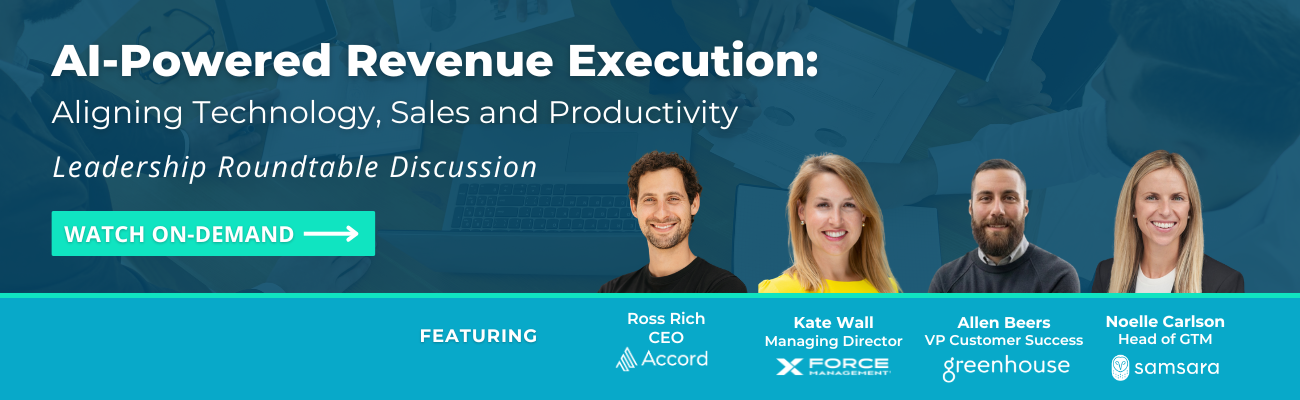
We recently explored this topic in a discussion with leaders from Accord, Greenhouse, and Samsara, where we unpacked what it takes to operationalize AI in a way that strengthens sales execution. Here are three reasons many AI investments fail to deliver the expected impact.
Reason 1: You started with the tool instead of the GTM strategy
Driven by competitive pressure, many organizations invested in AI before defining the business problems they wanted to solve. That led to disconnected pilots, unclear adoption expectations and tools that brought reps out of their workflows instead of strengthening execution. To drive quantifiable impact, revenue leaders should start with the GTM initiative first: What are we trying to improve? Whether it’s forecast accuracy or pipeline quality, defining the strategy first helps teams identify specific activities where AI can bring efficiency to the sales motion and improve execution.
As Ross Rich of Accord shared during the discussion, “You need to start with the people, then the process, then the tools. Tools only reinforce things.” This is where many AI initiatives fall short. AI can only reinforce what already exists. Without a clear sales motion, consistent messaging framework and common language for creating and qualifying value, AI has no reliable standard for what “good” looks like. Strong sales methodologies and execution processes give teams consistency and AI something concrete to scale across the organization.
Reason 2: You don't have a unified cross-functional approach behind your AI
Revenue growth requires a cross-functional approach – mastering AI-powered execution is no different. Organizations focused on improving ARR and NRR need coordination across acquisition, retention and expansion, which means post-sales teams need to operate in a unified AI ecosystem with your sales team.
When teams operate independently, each function optimizes its own tools, workflows, and metrics leading to friction for reps and a fragmented experience for buyers. AI can actually make those silos worse if it reinforces conflicting processes, competing definitions of value, and disconnected customer expectations.
“You really need people that will step up and drive cross-functional alignment,” Rich noted. It’s not just the teams that create the strategy, the leaders who organize it, and the people who implement it. You need to figure out a way to bring all of these people together.” Organizational alignment has long been considered a key to growth; a successful AI approach follows the same model.
The most successful leaders right now are designing AI-powered GTM ecosystems that support one unified revenue motion, instead of disconnected functional priorities. Shared messaging frameworks help AI drive outcomes across acquisition, renewal and expansion, while unified execution standards ensure AI-driven insights, prompts and workflows reinforce visibility across the organization.
Reason 3: Your data inputs are inconsistent and noisy
Many AI tools claim to improve forecasting, deal inspection, coaching and prioritization; but technology is only as effective as the information it receives. If there are inconsistencies with how reps input data into the CRM, AI can scale those inconsistencies and confidently produce inaccurate insights and predictions.
From Noel Carlson of Samsara’s perspective, “You cannot extract signal from noise. And most companies’ CRMs are just noisy today.” That’s the challenge many organizations are facing right now: high expectations for AI relying on fragmented CRM data and uneven sales execution.
Structured sales methodologies and messaging frameworks help solve that problem by creating cleaner, more reliable inputs. When teams follow the same approach to discovery, qualification and value messaging, they capture cleaner information needed to advance deals effectively. Managers also gain clearer visibility into opportunities to verify deal progression and identify data gaps early. Those higher-quality inputs give AI a much better foundation for accurate recommendations, coaching prompts and opportunity insights.
AI Should Reinforce Your Revenue Execution System
AI can improve sales execution, but only when the right foundation is in place. Without a clear GTM strategy, cross-functional alignment, and structured data inputs, AI will reinforce silos and amplify unreliable outputs instead of improving execution. Teams seeing the greatest return on their AI investment right now are using technology to strengthen proven methodologies, shared messaging and aligned execution standards across the business. If you’re looking for a framework to align people, processes and technology for stronger AI-driven execution, our Predictable Revenue Framework can help.
To hear how leaders from Force Management, Accord, Samsara and Greenhouse are thinking about AI-powered revenue execution, watch the full on-demand webinar.