As a RevOps leader in 2027, it's not enough to just stand up new tools and dashboards. To ensure your strategy delivers on revenue targets, you need your workflows to be used consistently and efficiently across the revenue function.
Fragmented systems and inconsistent adoption are what turn clean data models into untrustworthy pipeline signals. You can't manage the sales team, but you can build systems that account for the realities of day-to-day execution.
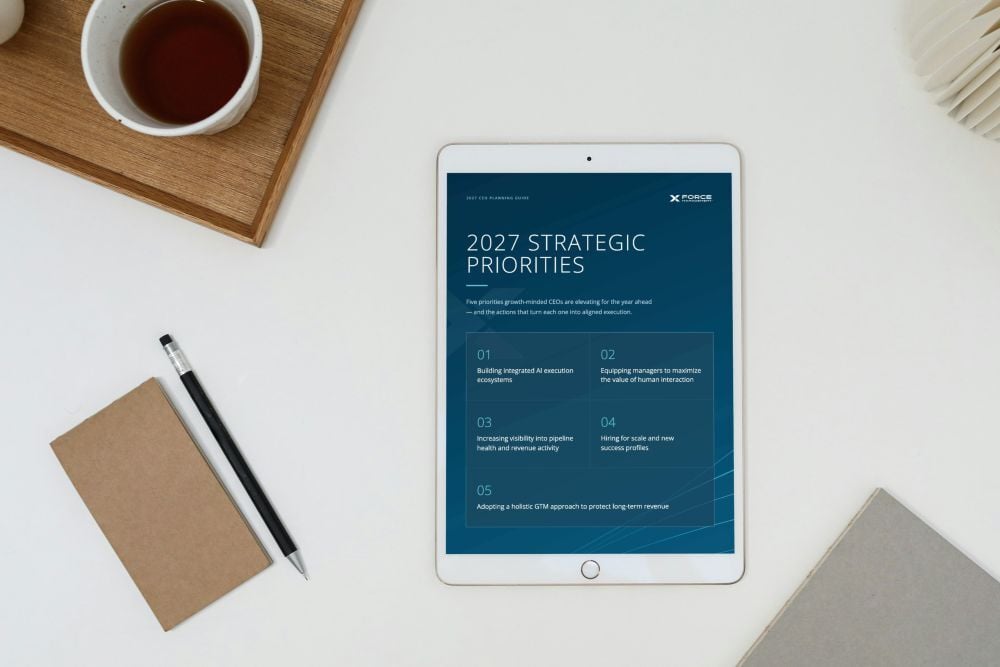
The 2027 RevOps Planning Guide is designed to help you close the gap between how your revenue systems operate in theory and how they actually show up in execution. Inside, we break down five strategic priorities growth-minded orgs are elevating for next year and outline how RevOps can influence them. Plus, a practical framework for identifying execution risks, setting data and process standards that protect your systems, and building governance that allows you to focus on evolving, not troubleshooting.
A clean tech stack and a strong revenue data model look great in a board deck. The real test is whether sales, marketing and CS actually use them the same way once they're live — and that's where most RevOps investment falls short.
1. AI tools gets layered on the existing process without critical analysis. Many teams assume that if new AI tools get connected to the CRM, they're automatically embedded in the sales process. Connection doesn't automatically equal adoption, and tech can't fix a broken foundational process. Audit existing processes to ensure that your tech is fixing the right problems, not just the ones you think you have; for the best results, develop new processes that play up the strengths of both your tech and your teams.
2. Data points are named, but not trained. It can be easy to assume that deal-level data is understood the same way by every rep, manager and leader. But if the process behind each stage exit criteria isn't clearly defined, the pipeline vision gets muddied quickly. Partner with sales leaders to develop the process for managers to verify and coach to deal data standards, so your reporting is always sound.
3. Revtech investments don't address team silos. The tech stack is optimized for the efficiency of each task, but the biggest efficiency risk is the handoff between teams. Closing the gap takes a shared definition of data, messaging and account ownership across the customer lifecycle, and it rarely happens without a top-down mandate and continued cross-functional focus.
4. Capacity models haven't caught up to how AI is changing the workflow. Many RevOps teams still size territories, quotas and headcount plans off productivity benchmarks that predate their AI rollout, so those assumptions no longer reflect how the job actually gets done day to day. Before finalizing next year's hiring and quota plans, partner with sales leadership to rebuild capacity models and success profiles around the AI-integrated workflow your reps are actually running, not the one they used to run.
In 2027, AI won't be an addition or investment to the existing sales process — it will be a catalyst to redesign the system . Partner directly with revenue and sales leadership to design comprehensive workflows where AI is embedded into an updated seller motion. That means jointly mapping where AI should change a specific behavior — in prospecting, deal qualification, or forecasting — and rebuilding the workflow around that outcome, rather than dropping a tool into the current process and hoping adoption follows. Structure reporting and set baseline KPIs around those specific use cases, not generic adoption metrics, so you can tell whether the new workflow is actually working.
Build a shared, documented exit criteria for every stage — one grounded in customer evidence like next steps, economic buyer engagement or a mutual close plan, not rep confidence. Require pipeline and forecast reviews to be evaluated against that same standard across every team so the number means the same thing everywhere it's reported.
RevOps can build the infrastructure that surfaces coaching moments — call intelligence, deal-risk flags, rep activity data — but that only creates value if coaching capability gets funded and developed with the same seriousness as the AI tooling itself. Track whether managers are using AI time savings on revenue-driving coaching, not just whether they've adopted the new dashboard.
If your GTM tech stack feels disjointed even after integrating and consolidating tools, it's time to look at the underlying motion. Fragmented processes will keep producing unreliable signals regardless of how tech-enabled they are. Real fixes require a mandate from executive leadership to align sales, marketing, product and CS on shared data, messaging and account ownership — it rarely happens without top-down pressure and continued focus.
Industry leaders turn to Force Management to help them develop revenue engines that get measurable results. We’ve partnered with over 150 companies that have reached unicorn status of over $1B in valuation.
When you need to deliver on board expectations or reach the next round of funding, Force Management can help develop the repeatable system you need — and get it executing at high efficiency, quarter after quarter. Don't take it from us; explore what leaders of high-growth unicorn companies have to say about working with Force Management.
© Copyright 2026 Force Management.